Monthly Archives: November 2009

Bob’s Clues to Doomed Project Managers

I was thinking back today about a conversation I had on a plane about ten years ago. It was my first long distance “onsite” as a control systems guy, and I was very excited. Next to me on the plane to Hertfordshire, Connecticut was a grizzled old technician, about a month away from retirement. I can’t for the life of me remember his name, but the name “Bob” would suit him, so I’ll call him that.

We got to talking about what brought both of us together in that plane that day. I was off to startup some machine with a program that was “almost done”, and Bob was coming back from a service call on some CNC machines.

I spent most of my time on that flight listening to his lifetime of stories. I distinctly remember his right hand was missing the little finger and the tip of the ring finger. “A press did that to me,” he said. “Didn’t get my hand out of the way in time.” I figured it probably happened years ago, before all the new safety standards were in place. “No,” he laughed, “just four years ago. Make sure you keep your hands in your pockets!” He pointed at me with his right hand as he said it, just for emphasis.

What really got Bob talking was when I told him I wanted to be a project manager some day. “Why the hell would you want to do that?” he said. “You like white hard hats and clipboards, do ya,” he smirked. I got the sense Bob had seen a lot of project managers come and go in his day. You might say he viewed them with a critical eye. Still, we talked a bit more, and Bob related to me a kind of “system” he had for spotting, what he called, the “Doomed Project Manager”. He said all you have to do is listen for some key phrases, and that’s enough to tell you if a PM is a rising star or on the next train to dooms-ville.

Now I’ve been very fortuitous in my career. I’ve never actually heard anyone I’ve worked with ever say anything like this, and that’s certainly a testament to the professionalism and dedication to excellence of all the teams I’ve ever had the pleasure of working with. Certainly, I’ve never said any of these things. Still, I think Bob’s advice might ring true for other teams that might be struggling with their own instance of a doomed project manager. Therefore, here are Bob’s Clues to Doomed Project Managers, as closely as I can remember them:

1. “We just need to buckle down”

“If I had a nickle for every time a PM talked about buckling down,” said Bob. “What this really means is he doesn’t see any obstacle that can’t be overcome with lots of unpaid overtime. I imagine old King Tut buildin’ his pyramid talked to his people a lot about buckling down.”

“The problem,” said Bob, “is that they get addicted to it. The solution to every problem on every project is to buckle down. They don’t learn to plan it better next time, have the parts ordered a week earlier just in case, have the drawings reviewed by someone else, or whatever. Why bother when you can make it someone else’s problem?”

2. “We’re a little behind, but I think we can make it up”

“On the surface, this sounds a lot like the buckle down thing, but there’s a subtle difference. In fact you’ll often hear them used together, like we’re a little behind schedule, but I think we can make it up if we just buckle down. What you’ve really got on your hands here is an incurable optimist. The best predictor of future performance is past performance, but this fella thinks yeah, it’s been going bad so far, but for no reason whatsoever, I think it’s about to turn around and go the other direction.

3. “We know you like to do things the right way, but…”

“I’ve been around a few years now, and I find I’m now the guy they call in to go fix stuff that’s already behind schedule and over budget. So I really think it’s great when they pull you into their office and say we know you like to take the time to do things right, but we’re way behind schedule and over budget here, so take whatever shortcuts you can to get it to work, and we’ll have to fix the rest on the next job. The irony of this is apparently lost on the poor doomed PM, because it’s almost always the rushed, half-assed job that he told the guy before you to do that got him into this mess in the first place.”

4. “We didn’t have time to…”

“This is my favorite,” said Bob. “The customer comes to you and says the widget doesn’t do what he wanted it to do, and you say of course we can do that!… but let’s take a look at the spec to see if it’s supposed to be included, or if it’s an extra. You call the PM and he says, I remember them saying in a meeting they didn’t want that, but we were over budget and behind schedule so we didn’t have time to update the spec. Then you end up doing days of rework to make up for the 30 minutes of typing he saved. The PM’s whole job is to plan, document and manage the scope of the job. If he wasn’t doing that, who was managing the project?”

Others?

There were some other clues I just can’t remember, but those were the ones that stuck with me. Does anyone have clues of their own they would like added to the list?
ZigBee… Where are you?

Years ago I experimented with X10 in our old house. It was cheap and fun, but it was unreliable. Not long after, I heard about this great new technology called ZigBee that would form a wireless mesh network between all the devices in your house, and communications between modules would retry and reroute around problems. I was impressed! It seemed to good to be true!

Apparently it was. Here we are, 5 years later, and where is my X10 replacement? From what I can tell, the electric utilities are starting to deploy ZigBee (and our house in Ontario was just upgraded with a “smart meter” which most likely has ZigBee technology in it). Great, but I can’t seem to find a single off-the-shelf ZigBee home automation product. It’s been 5 years!

Is it time to forget about ZigBee for Home Automation? We’ve blanketed our houses in WiFi. It can’t be that hard to put an 802.11 chip in a wall socket. It looks like Control4‘s products do just that. Anyone know of any off-the-shelf WiFi enabled light switches?

Automating the Home, Failed

A couple of years ago we moved into a nice new home, and like most new homes it had a shiny new HRV.  I had never seen one before, and I was impressed by the idea that it exchanged stale inside air with fresh outside air but it conserves the energy you’ve already invested in heating or cooling the inside of your home.  I actually pulled the cover off to study how it worked, and pulled the cover off the furnace to see how it was hooked in.

The HRV draws air from the bathrooms, kitchen and laundry areas in the house (because they are your sources of moisture) and exhausts that air outside, but brings in an equal amount of air.  Rather than distributing the incoming air back into the house itself, the HRV dumps it into the furnace airflow, and sends a signal to the furnace to run whenever the HRV is on.

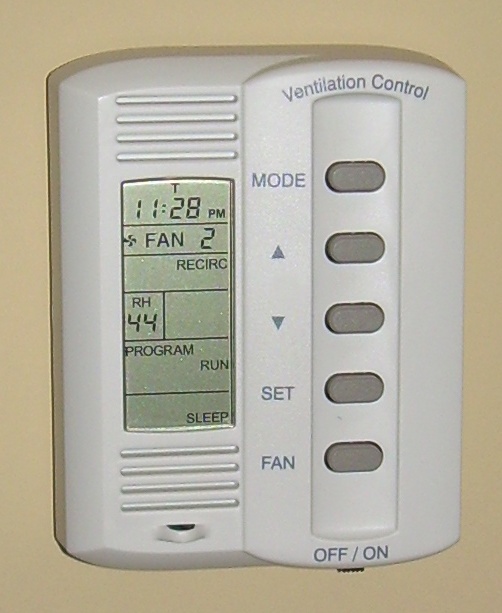
When we received the keys to our home, the builder instructed us to leave the HRV on at its lowest level 24 hours a day to prevent humidity, particularly at the beginning as the home is wet from construction and you need to let it dry out.  Makes sense.  After about a year though, I had this idea that running the furnace fan 24/7 at full speed just because the HRV was running at its lowest speed probably wasn’t the most energy efficient setup, particularly since the HRV itself is supposed to be an energy saving device.  After doing a bit of research, I discovered the manufacturer of our HRV made something called a Lifestyles Controller.  This is basically just like a programmable thermostat, but it controls your HRV.  You can program it to start and stop at different times of the day, operate in different modes and at different speeds depending on the need, etc.  Great!

HRV-ControllerMy odyssey started when I attempted to purchase this marvel of technology.  The manufacturer wouldn’t sell me one because I needed to go through an authorized distributor, and of course there was only one in my area.  I contacted them and they’d never heard of this device.  I gave them the part number and they had to get back to me.  When they called me back, they asked me why I wanted to buy it, and acted like this was a huge inconvenience for them (imagine, a customer calls you and wants to buy something).  That should have been my first clue of the dangers to come.  I insisted that I wanted to buy one, and yes, I’m quite capable of installing it myself, and yes, I understand it’s a special order item and there are no returns.  Did I mention it was expensive too?

When I went to pick it up at the distributor, they were very careful to tell me that I must unplug the HRV before installing this or else I could easily short out the power supply.  I don’t mean they told me this once or put a note on the package to remind me, but several people made it really clear not to do anything with it plugged in.  Makes sense.  I’m used to rewiring stuff and I always turn the power off.  Again, this was a sign, and I didn’t heed it.

I got the device home, unpacked it and set to work installing it making sure to unplug the HRV first.  The instructions were very simple and easy to understand.  I didn’t bother running wires through walls at this point; I just wired it up about 3 feet away from the HRV (my history in automation has taught me to avoid commitment).  When I finished wiring, I plugged the HRV back in, the lifestyles controller powered up, and… wouldn’t control the HRV.  I followed the instructions to the letter and just couldn’t get it to ever start the HRV even with the button that just manually starts the HRV on a timer.  I tried a couple of other ideas, like disconnecting the existing bathroom control pads, etc. (unplugging it every time!), but nothing seemed to work.  I dreaded the next obvious step.

I called the distributor.  “The lifestyles controller for my HRV doesn’t work.”

“Did you install it without unplugging the HRV?”

You can imagine the rest of that conversation.  Nothing surprising.  They asked me to call the manufacturer and talk to their tech support.  Again, “Did you install it without unplugging the HRV?”  Grrr.

The manufacturer told me I had to take it back to the distributor who would return it to them, which was quite funny since all three of us were located in the same city!  Anyway, here I am back in the distributor’s office, and the woman behind the counter takes a look at the device, bewildered, looks at my receipt and says, “This is a special order item.  There are no returns.”

“I don’t want to return it.  I just want one that works.”

“Oh.”

They did send it back and lo and behold, there was nothing wrong with the device.

“Wait, what?!?”

“They tested it and there’s nothing wrong with it.  However, it’s only compatible with HRV firmwares after October 2006.  When did you purchase your HRV?”

“We got the house in September of 2006.”  At least that made sense.  Maybe we were getting somewhere.

“The manufacturer has offered to provide an upgraded controller board free of charge, but it’s not something you can install yourself.  We’ll have to come and install it, and our hourly rate is blah and there’s a minimum charge of blah.”  (I can’t remember the exact price, and I’d probably just get angry if I did.)

At that point I figured, if I’m paying a minimum charge anyway, why not have them come and install the whole thing, and get it put in the right spot, run the wires, etc.  Great.  Wait, it gets better.

Buddy comes to install the gadget.  He’s got the new controller board, and gets that installed pretty quickly, but when he asks me where I want the controller, I tell him I want it right beside the existing programmable thermostat, in the hall upstairs.  He takes a walk around, takes a look from the basement, turns to me and tells me he didn’t bring a ladder with him.  No problem, I say, I have a couple in the garage, and it’s not terribly surprising that he wouldn’t have a ladder anyway.  Wait, it gets better.

He also had to borrow my drill, and an electrical fish to get the wire through the wall.  Wait, it gets better.

“What gauge wire do you figure this needs?” he says.

You’re asking me?  I have to take a day off work to pay you hundreds of dollars to borrow my tools to install a product you sell and you’re asking me what gauge of wire you need?  Wait… it gets better.

“I didn’t bring any wire with me.”

“No problem,” I say.  “I’ve got a whole whack of telephone cable in the garage, and it’s at least the gauge of wire that the rest of the HRV communication uses, so it should be fine.”

So we set to work running the wire.  Just to put the icing on the cake, when we go to punch the hole in the drywall where the controller is going to be mounted, we discover there’s a plywood blocker just behind the drywall in that spot.  I grab the drill, put a spade bit in it, and drill an inch diameter hole through the plywood.  Then I discover there’s another wire back there… interesting.  I just drilled through it actually… I wonder what that belongs to.  It turns out that was the wire that goes to the glass break detector on the security system.  Had to fix that too, but that was my fault.

We got the whole thing installed and wow!  It worked!  Buddy gave me a discount for having to use my tools, and I was a happy geek, programming my HRV.

That is, until a few months later when I noticed the humidity in the house was through the roof.  The controller was still “on”, but it was obvious it had stopped controlling the HRV.  I’m not sure what caused it to fail, but thankfully it was still under warranty.  I got it replaced.  The one I got back works.  I’m holding my breath…

That’s my latest foray into home automation, and I’m not impressed.  In my job in industrial automation, I can actually install and program the industrial controllers myself, and when I talk to the distributors and manufacturers, nobody treats me like a moron.  Home automation is still in its infancy, so the only people doing this themselves are generally early adopters like myself: technical and geeky.  Treating us like this is completely counter-productive.  I hope some company, somewhere, steps up to the plate and starts working with us, not against us.